WBS in Practice: How to Create a Work Breakdown Structure Step by Step
Learn what a WBS (Work Breakdown Structure) is, how to create one step by step, and explore a practical example to better organize your projects, reduce risks, and improve delivery control.
5/17/20263 min read


Introduction
Managing a project without proper organization can quickly lead to delays, rework, and a lack of clarity among teams. In many cases, the problem is not the execution itself, but the way the project was structured and planned from the beginning.
This is exactly where the WBS becomes one of the most important tools in project management.
A Work Breakdown Structure (WBS) helps divide large deliverables into smaller and more manageable parts, providing a clear view of everything that needs to be executed. With a WBS, planning becomes more organized, responsibilities are better defined, and project monitoring becomes far more efficient.
In this article, you will learn what a WBS is, why it is essential for project success, and how to create an effective structure through a simple and practical example.
What is a WBS?
A WBS (Work Breakdown Structure) is a hierarchical decomposition of the project work. Its purpose is to organize all the deliverables required for the project to be completed successfully.
In practice, it works as a visual map of the project, breaking the work down into smaller levels until it reaches components that can be easily planned, monitored, and controlled.
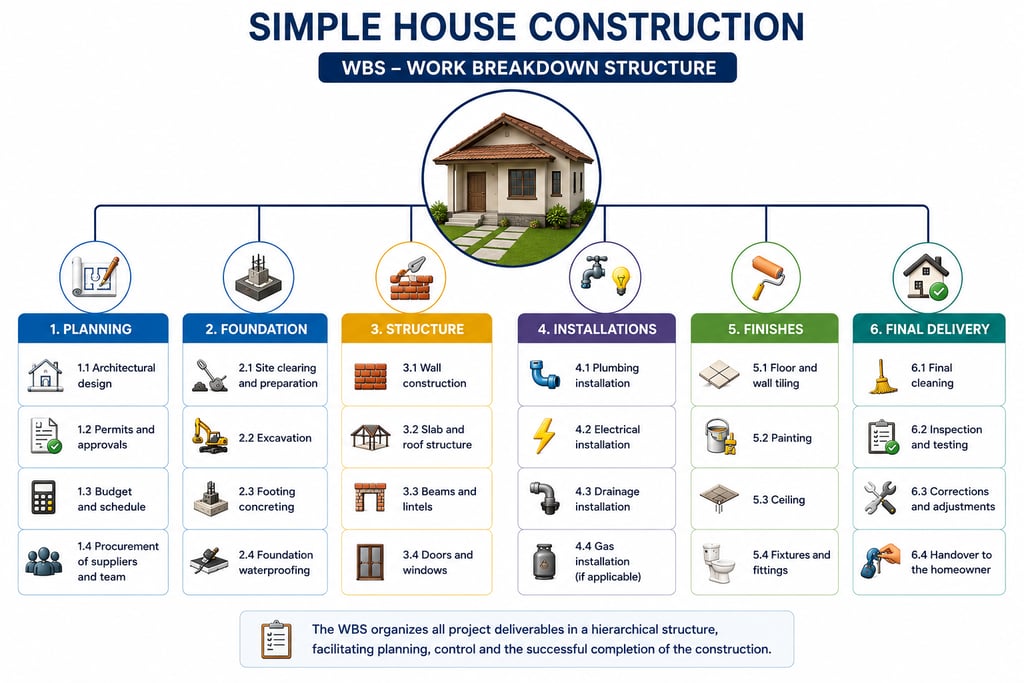
Imagine a simple house construction project. Instead of treating the entire construction as a single activity, the WBS organizes the deliverables into categories such as:
Foundation
Structure
Installations
Finishing
Painting
Final Delivery
Then, each of these areas can be further detailed into smaller levels.
This structure greatly simplifies project management and reduces communication failures throughout execution.
Why is the WBS So Important?
Many projects face problems due to a lack of organization and clarity in deliverables. Without a solid structure, it is common to encounter rework, delays, unexpected costs, and difficulties in project monitoring.
The WBS helps prevent these issues by organizing the project clearly and facilitating planning, activity control, and responsibility definition. In addition, it improves team communication and makes progress tracking much simpler.
How to Create a WBS Step by Step
Creating an effective WBS does not need to be complicated. The key is to divide the project in a logical and organized way.
1. Define the Main Project Objective
The first step is to understand what the final project deliverable will be. Example: Build a simple two-bedroom house. This will become the main foundation of the WBS.
2. Identify the Major Deliverables
Now divide the project into major sections. For example:
Planning
Foundation
Structure
Installations
Finishing
Final Delivery
These groups represent the main components of the project.
3. Break Down the Deliverables
Next, each group should be divided into smaller parts. Example: Installations
Electrical installation
Plumbing installation
Lighting installation
4. Create Work Packages
Work packages represent the lowest level of the WBS. They should be clear enough to allow:
Control
Estimation
Responsibility assignment
Progress measurement
5. Review the Structure
Before finalizing, verify that:
All deliverables have been included
There are no duplicate items
The level of detail makes sense
The structure is easy to understand
Practical example of a WBS (Work Breakdown Structure)
Special Tip: How to create a truly effective WBS
Often, the biggest challenge is not creating the WBS itself, but finding the right balance in the level of detail. Here are some important tips:
Don’t turn the WBS into a schedule
The WBS represents project deliverables, not necessarily the sequence of activities. The project schedule should be developed afterward.
Avoid excessive detail
Over-detailing can make the structure difficult to maintain and update. The ideal approach is to define a level of detail that supports management without creating unnecessary bureaucracy.
Involve the team in the process
Building the WBS with different project stakeholders helps identify important deliverables that might otherwise be overlooked. It also increases alignment across teams.
Conclusion
The WBS is one of the most important tools in project management because it transforms complex projects into organized, clear, and much more manageable structures.
When properly developed, it improves planning, reduces risks, facilitates progress tracking, and significantly increases project control.
More than just a document, the WBS serves as a strategic foundation for the entire project execution.
Regardless of project size, investing time in building a solid WBS is a decision that leads to better organization, predictability, and a much higher chance of success.
And you — have you ever created a WBS for a project? Share your experience or send your questions below.
Contact
Get in touch with us for questions or suggestions
contato@eiplanejador.com
© 2025. All rights reserved.