Project Life Cycle: How to Plan, Execute, and Deliver Successfully
Discover how the project life cycle can transform the way you manage your initiatives, bringing greater organization, predictability, and results.
ESTRUTURA, CONCEITOS E MODELOS DE GESTÃO
5/2/20264 min read
Introduction
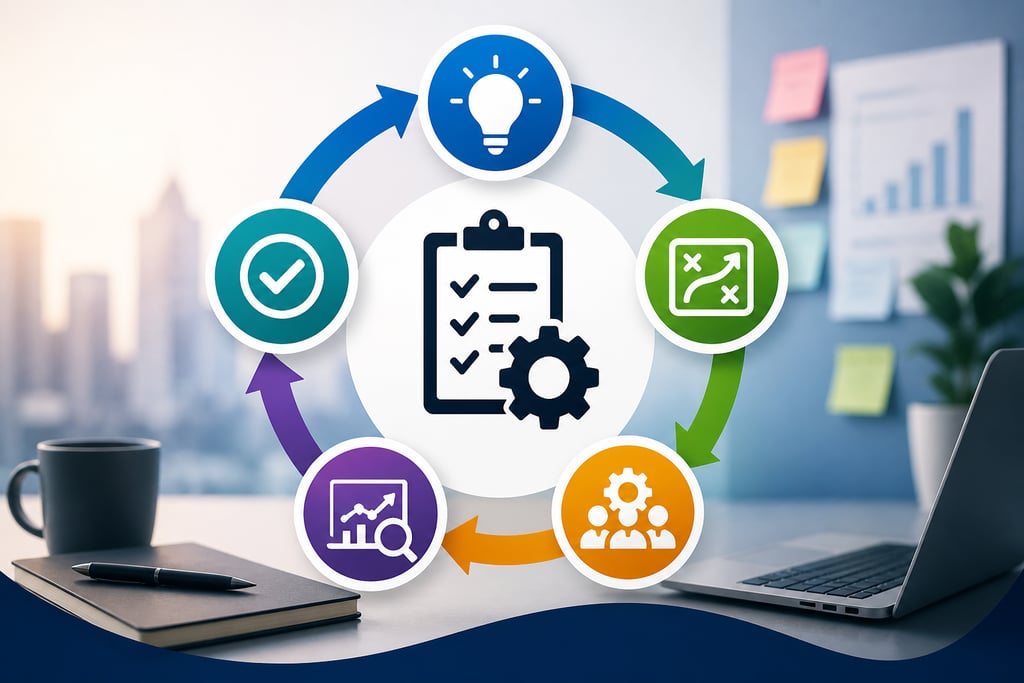
Every project, regardless of its size or complexity, follows a path from its initial concept to final delivery. This structured path is known as the project life cycle.
In practice, understanding this cycle goes far beyond simply following a methodology. It is about creating predictability in an environment that is naturally uncertain. Projects that fail to respect these stages often suffer from delays, budget overruns, and misalignment among stakeholders.
If you have ever felt like you were working intensely on a project without seeing clear progress, it is possible that one of the phases was neglected or carried out without the proper structure. That is exactly what the project life cycle is designed to prevent.
What Is the Project Life Cycle?
The project life cycle is a framework that organizes all the phases a project goes through, from identifying a need to its formal completion.
More than just a sequence of stages, it works as a decision-making guide. It allows managers and teams to clearly understand the current stage of the project and determine the most appropriate next steps.
In practice, this leads to greater control, better communication, and a much stronger ability to anticipate problems before they become critical.
A Practical Example for Context
Imagine a company struggling to organize its projects. Deliveries are delayed, information is scattered, and communication between teams is not flowing as it should. Faced with this situation, the company decides to implement a new project management system.
This project, although seemingly simple, involves several decisions, alignments, and stages that need to be managed carefully. Using this example, we can better understand how the project life cycle applies in practice.
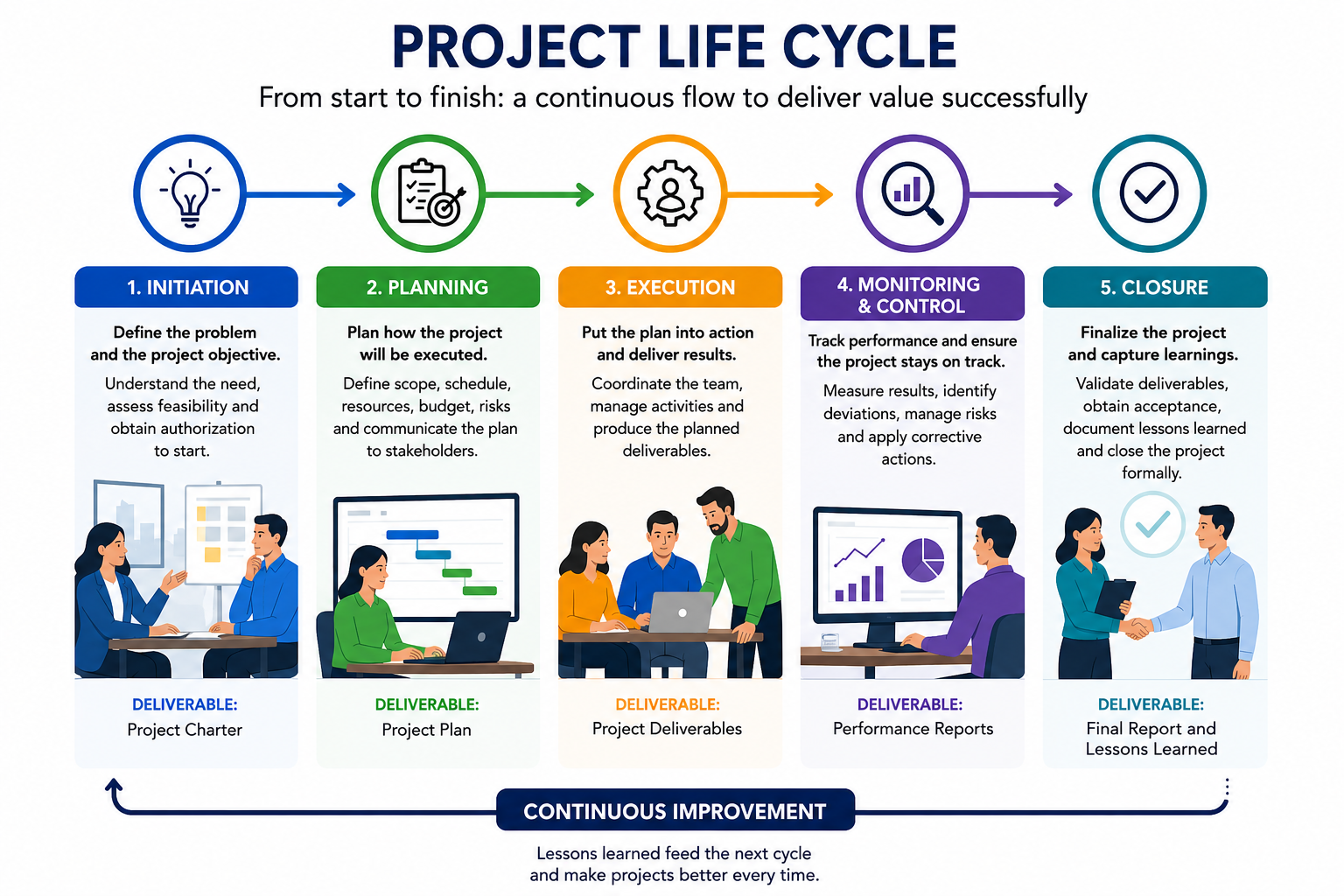
Project Life Cycle Phases
Initiation
Initiation is the moment when a project stops being just an idea and begins to take shape in a structured way. In the example presented, this is when the company recognizes that there is a real issue in its project management processes and starts evaluating possible solutions.
This is a moment of strategic reflection. It is not enough to simply want to execute a project; it is essential to understand whether it truly makes sense. Questions related to feasibility, business impact, and expected return must be considered.
When this stage is handled properly, the project starts with a clear direction. Otherwise, there is a high risk of investing time and resources into something that will not deliver the expected results.
Planning
Once the project is approved, the next step is to structure the path forward. Planning transforms intention into a concrete action plan.
In the case of implementing a management system, this is the stage where the scope, timeline, required resources, and potential risks are defined. It is also the moment when expectations are aligned among everyone involved, helping to avoid misunderstandings later on.
Well-planned projects do not eliminate unforeseen issues, but they significantly reduce their impact. Effective planning brings clarity, organization, and confidence to the team.
Execution
Execution is where the project comes to life. This is the stage where the plan moves from paper into real deliverables.
In our example, this includes system configuration, data migration, and user training. It is a dynamic phase that requires constant coordination and effective communication among all stakeholders.
It is important to understand that execution does not mean rigidly following a plan without adjustments. Throughout the process, changes are often necessary, and the ability to adapt becomes a key factor in project success.
Monitoring and Control
While execution takes place, monitoring ensures that everything stays on track. This phase happens continuously and follows the project in real time.
In the scenario presented, imagine that the data migration process starts falling behind schedule. Without monitoring, this issue could go unnoticed until it becomes critical. With proper tracking, however, it is possible to react quickly, adjust the plan, and minimize impacts.
Monitoring provides visibility. It enables decisions to be made based on data rather than assumptions.
Closing
Closing marks the formal completion of the project. In the example, this happens when the system has been implemented, validated, and is already being used by the team.
However, closing a project goes beyond simply finishing activities. It is the moment to evaluate results, understand what worked well, and identify opportunities for improvement in future initiatives.
Projects that go through a proper closing phase leave an important legacy for the organization, directly contributing to the growth of project management maturity.
Tip for Modern Scenarios: The Role of Artificial Intelligence in the Project Life Cycle
Artificial Intelligence has been gaining space in project management due to its ability to analyze large volumes of data and generate valuable insights.
During the initial phase, AI can support feasibility analysis by cross-referencing historical information and identifying patterns that often go unnoticed. During planning, intelligent tools can already suggest more realistic schedules and identify potential risks based on similar projects.
In execution, AI contributes by automating repetitive tasks and improving communication between teams. In monitoring, its role becomes even more evident through predictive alerts that help anticipate delays and deviations.
During closing, technology helps consolidate lessons learned in a structured way, making them accessible for future projects.
What makes AI especially valuable is that it does not replace the project manager — it enhances their analytical and decision-making capabilities.
Conclusion
Understanding the project life cycle is essential for transforming good ideas into concrete results. By structuring a project into clear stages, you reduce uncertainty and significantly increase the chances of success.
The example of implementing a management system demonstrates that, regardless of the type of project, following a structured workflow makes all the difference. Each phase has its own role and contributes directly to the final outcome.
In practice, projects rarely fail by chance. Most problems arise from the lack of proper planning, insufficient monitoring, or misalignment among stakeholders.
Mastering the project life cycle is therefore a strategic skill. It enables professionals to lead initiatives with greater confidence, control, and predictability in an increasingly dynamic and challenging environment.
Contact
Get in touch with us for questions or suggestions
contato@eiplanejador.com
© 2025. All rights reserved.